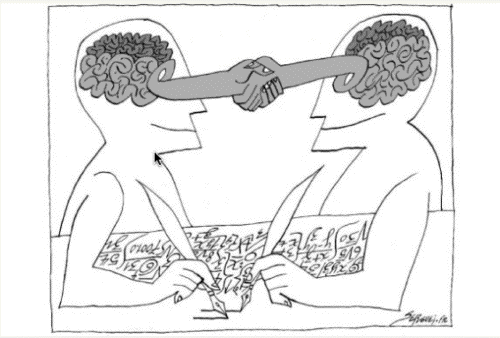
That is to say, mythogenetics: agentive and intentional memes enact narrative memes . . .
How about stories as "grammatical games" that consist chiefly of nouns (agents) and verbs (actions)—and, by extension, adjectives and adverbs. Verbs as "intentional memes"—with nouns as agentive memes, perhaps (see http://onlyagame.typepad.com/only_a_game/2005/10/fractal_stories.html).
From game design theory (see also—by way of a contrast—"We hate memes, pass it on . . ." http://neuroanthropology.net/2008/06/12/we-hate-memes-pass-it-on/).
Friday, May 15, 2009


How to Write a Novel: The Snowflake Method
 From "How to Write a Novel: The Snowflake Method" by Randy Ingermanson:
Our fundamental question is this: How do you design a novel?
For a number of years, I was a software architect designing large software projects. I write novels the same way I write software, using the "snowflake metaphor." OK, what's the snowflake metaphor? Before you go further, take a look at this cool website [http://math.rice.edu/~lanius/frac/koch/koch.html].
At the top of the page, you'll see a cute pattern known as a snowflake fractal [see above]. Don't tell anyone, but this is an important mathematical object that's been widely studied. For our purposes, it's just a cool sketch of a snowflake. If you scroll down that same web page a little, you'll see a box with a large triangle in it and arrows underneath. If you press the right-arrow button repeatedly, you'll see the steps used to create the snowflake. It doesn't look much like a snowflake at first, but after a few steps, it starts looking more and more like one, until it's done.
The first few steps look like this:


I claim that that's how you design a novel—you start small, then build stuff up until it looks like a story.
The same might be true of building up evidence to support your thesis or point (which, in a standard five-paragraph essay, might be viewed in its three aspects—or sides, i.e. like triangulation).
Thursday, May 14, 2009
Stanley Fish on Theory Minimalism (2000)
In 2000, Fish wrote . . .
I have just returned from the AALS (American Association of Law Schools) meeting in Washington, where I was a member of a panel considering the state of legal theory at the beginning of the new century. I gave my standard stump speech (called "Theory Minimalism"), which always makes the same three points:
1) if by theory you mean the attaining of a perspective unattached to any local or partisan concerns but providing a vantage point from which local and partisan concerns can be clarified and ordered, the theory quest will always fail because no such perspective is or could be available; [theory as a vantage point, i.e. a supra-contextual "grounding," is unavailable, cf. Heidegger on theoria (= the God's eye view, i.e. the theos-eye]
2) the unavailability of that supra-contextual is in no way disabling because in its absence you will not be adrift and groundless; rather you will be grounded in and by the same everyday practices—complete with authoritative exemplars, understood goals, canons of evidence, shared histories—that gave you a habitation before you began your fruitless quest for a theory; [. . . but you're grounded in everyday, i.e. historical and therefore revisable, practices anyways] and
3) nothing follows from 1) and 2); knowing that resources of everyday life are all you have and knowing too that such resources are historical and therefore revisable will neither help you to identify them nor teach you to rely on them with a certain skeptical reserve; the lesson of 1) and 2) goes nowhere; if grand theories provide no guidance (because they are so general as to be empty), the realization that grand theories provide no guidance doesn't provide any guidance either. [. . . BUT, knowing this won't make everyday practices any easier to identify or be sceptical about, i.e. they aren't available as a "ground" either.]
End of story, end of theory as an interesting topic.
I like this argument because no one else does. Those on the right don't like it because they have a stake in believing that without the foundations of fixed and absolute verities, the world will go to hell in a handbasket. Those on the left don't like it because they have a stake in believing that in a world where truths are always being revised and authorities dislodged, we can sweep old structures away and begin from scratch to build the just society. This means that I am never in danger of persuading everyone or even many; and that means that I'll never have to give up the argument because there will always be those who don't get it and complain (as did two members of the audience) either that I have undermined certainty and stability, or that I haven't.
Sunday, May 10, 2009
The Darwin-Wallace explanation of evolution: "Darwinism"
Richard C. Lewontin, "Why Darwin?," The New York Times Review of Books 56.9 (28 May 2009).
The Darwin-Wallace explanation of evolution, the theory of natural selection, is based on three principles:
1) Individuals in a population differ from each other in the form of particular characteristics (the principle of variation).
2) Offspring resemble their parents more than they resemble unrelated individuals (the principle of heritability).
3) The resources necessary for life and reproduction are limited. Individuals with different characteristics differ in their ability to acquire those resources and thus to survive and leave offspring in the next generations (the principle of natural selection).
One can hardly imagine anything that would have better justified the established social and economic theories of the Industrial Revolution than the claim that our very biological natures are examples of basic laws of political economy [thus, "Darwinism" = "Biological Competitive Capitalism"].
i.e.
The theory of competitive socioeconomic success is a theory about the rise of individuals and individual enterprises as a consequence of their superior fitness [the few over the many].
but
The theory of evolution by natural selection, in contrast, is meant to explain the adaptation and biological success of an entire species as a consequence of the disappearance of the less fit [the many over the few].
THUS
If we seek a true originality in the understanding of Darwin and Wallace, it is to be found in their ability to adapt a theory meant to explain the success of a few to produce a theory of the success of the many [i.e. "Darwinism" is socialist—or, historically speaking, Utilitarian].
What it lacked is an understanding of heredity. Mendel saved the theory: his experiments on peas demonstrated that inheritance was not based on the blending of some fluid-like material, but by the passage of particles that maintained their individual properties even when mixed together in a hybrid [thus, DNA].
In full historical justice, if we are to personalize our modern explanation of evolution we should call it not "Darwinism," nor even "Darwin-Wallacism," but "Darwin-Wallace-Mendelism."
Sunday, May 3, 2009
Interpenetralium
Mind-world/world-mind meld: the interpenetration of the internal psychical and physiological systems of the individual and the external environment.
Imago Templi = Sophia = Penetralium
but here the Truth is in the weft of inner and outer
legendary psychasthenia
Imago Templi = Sophia = Penetralium
but here the Truth is in the weft of inner and outer
legendary psychasthenia
A concept developed by the social theorist Roger Caillios, legendary psychasthenia refers to the ability of some animals to alter their appearance in response to their physical environment. A chameleon, for example, changes color in order to blend into its surroundings. Caillois compares this biological phenomenon to psychological experiences of subjects who perceive themselves becoming absorbed into, or mixed up with, the physical space surrounding them (one of his examples is the fear of the dark). For Lacan, this idea offers a useful model of a transformation in an individual through an encounter with an external stimulus.
transitivism
Child psychologist Charlotte Buhler observed that very young children often do not distinguish sharply between their own experiences and those of others—if one child falls and is injured, for example, another child may cry.
Lacan presents such references to external, formative influences on the development of the ego to support his argument that ego does not emerge sui generis—out of itself—but is the product of a dialectical interaction between the psyche (Innenwelt) and the external world (Umwelt)—an interaction perpetuated in life in the interaction of the subject and the other.
It comes down to . . .
Kohler's gestalt moment, in which the elements of a task or problem—or a self—come together: the ah-ha experience (Aha-Erlebnis), e.g. in the mirror stage [cf. Nietzsche on Apollo/Orpheus and the principium individuationis],
versus
the fragmented body, where the infant experiences his or her body as uncoordinated, vulnerable, and insufficient; this propels the infant toward identification with the (apparently) unified and stable imago of the mirror reflection or of the caregiver (or of the Umwelt, perhaps), though he or she remains haunted by the contrary image of their fragmentation [cf. Nietzsche on Dionysus Zagreus/Pentheus, torn apart by the maenads = σπαραγμός, sparagmos].
Cf.
1. Niran Bahjat Abbas, Thinking Machines: Discourses of Artificial Intelligence (LIT Verlag Berlin-Hamburg-Münster, 2006) 97-98.
2. John Keats: "Negative Capability, that is when man is capable of being in uncertainties, Mysteries, doubts, without any irritable reaching after fact & reason—Coleridge, for instance, would let go by a fine isolated verisimilitude caught from the Penetralium of mystery, from being incapable of remaining content with half knowledge" (Letter to George and Thomas Keats [21 Dec 1817], in H. E. Rollins (ed.), Letters of John Keats, vol. 1 [1958] 193-94).
Sunday, April 19, 2009

Wednesday, April 15, 2009
The Rings of Saturn
Your eyes have changed—
I can see the blue,
as if you’ve opened up to the view.
And if that feels strange,
well, it’s true: you’re created
from fragments of shattered moons . . .
Trust yourself
to do what you do—
the Golden Age is
within us too.
Return from whence you came;
the Great Year comes round again.
Swallow your dark thoughts—
you know they are your children—
and watch them grow into better, not bitter things.
And if that feels strange,
well, it’s true: you’ve created
a world from your shuttered dreams.
Trust yourself . . .
Key—A lyric written to commemorate my fortieth year, when I first noticed that my eyes had developed a blue ring around the iris.
Saturn, a.k.a. Cronus (Father Time), ate his children to stop them from usurping his power; I use the image to represent turning one's dark fears/desires to the "good." His was the Golden Age of Greece. I associate his reign with the return of the Great Year (the 40,000 year cosmic cycle) and Alexander Cockburn's idea that each of us bears a Golden Age within us, for me that being represented by my recognition that it's our evils that make us who we are—just as we are made of star-stuff transmuted.
The Rings of Saturn (Die Ringe des Saturn: Eine Englische Wallfahrt) is, of course, a W. G. Sebald memorial history (1995; London: Harvill Press, 1998).
Subscribe to:
Posts (Atom)